Sale
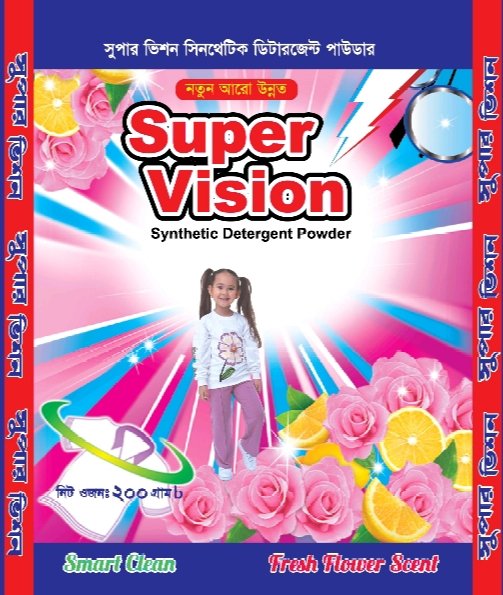
Super vision Detergent Powder
Special Price New Price Tk.60
Regular Price: Tk. 75
- You Save Tk. 15.00 (20%)
Synthetic Detergent clothes washing powder.
Color
Size
1. Chemical Discrimination (Classification of Types)
By Ionic Charge:
- Anionic Detergents: The most common type used in household laundry powders. They carry a negative charge and rely heavily on ingredients like Sodium Linear Alkylbenzene Sulfonate (NaLAS), which are highly effective at lifting out mud, clay, and ground-in dirt.
- Non-ionic & Cationic: These carry no charge or a positive charge respectively. While non-ionic surfactants are typically found in liquids to fight grease, they are sometimes blended into powders to assist with versatility. [1, 2, 3, 4, 5, 6]
By Concentration:
By Additives:
.
- Enzymatic Powders: Formulated with active enzymes to degrade organic proteins (blood, grass, milk stains).
- Phosphate vs. Phosphate-Free: Historically separated by their use of water-softening phosphates. Modern powders are heavily discriminated in favor of phosphate-free formulas to prevent environmental water pollution.